Meylen

Window Systems — Schüco AWS

One handle.
Two modes.
No compromise.

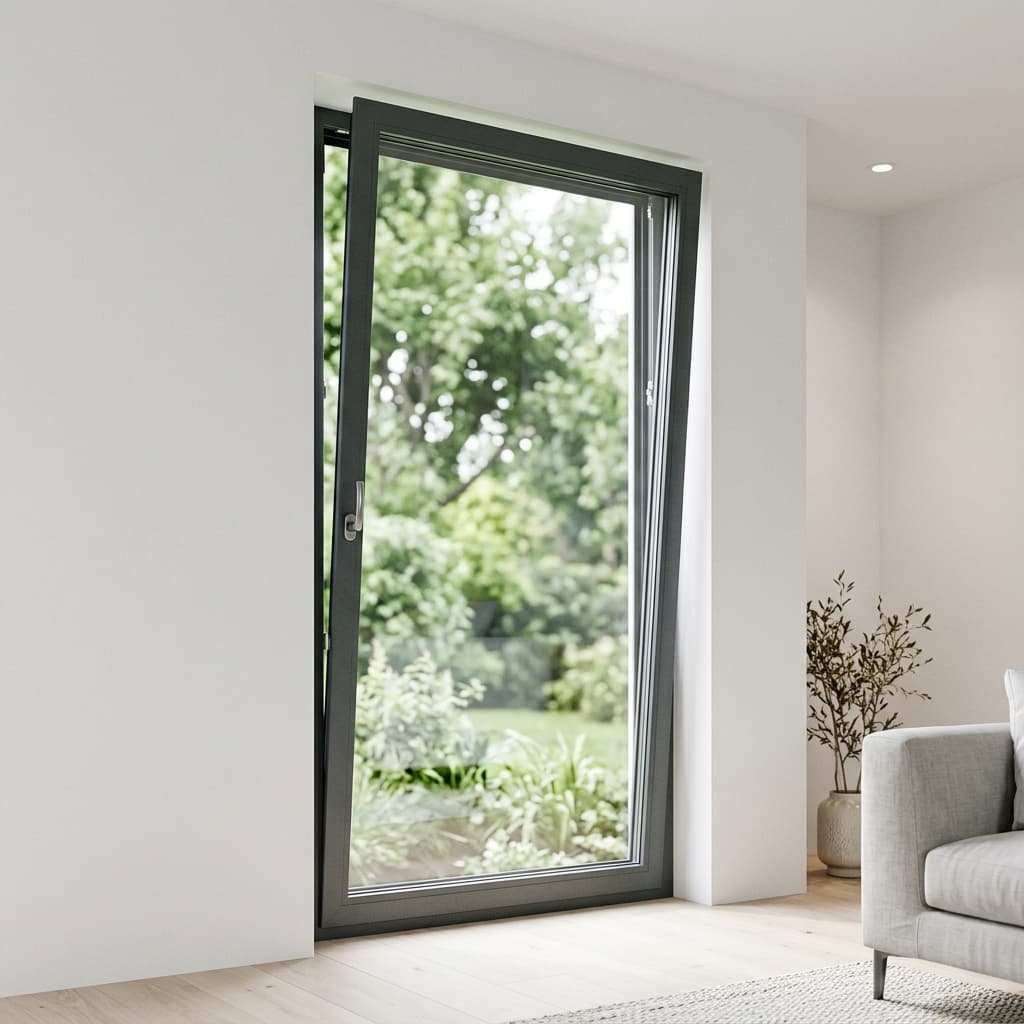
The tilt-and-turn mechanism is the defining innovation of German fenestration engineering. Unknown to most of the world — ubiquitous to every European who has lived with one. A single handle rotation delivers controlled tilt ventilation or full inward opening, with airtight closure at every other angle.

Schüco tilt-and-turn window open in turn position — luxury interior with garden view

The Mechanism

Three positions.
One handle rotation.

The elegance of the tilt-and-turn lies in its mechanical simplicity. A single espagnolette rod, driven by 90° handle increments, sequentially engages different locking geometries — routing the sash movement between tilt axis (horizontal, at bottom) and turn axis (vertical, at side hinge).

This is not a compromise between two window types. It is a purpose-engineered mechanism designed from the ground up for dual-axis control. Schüco's AWS platform refines this geometry across three handle positions, each with distinct hardware engagement — eliminating the possibility of accidentally selecting the wrong mode.

Tilt-and-turn window diagram showing three handle positions: closed, tilt, and turn
Handle down (6 o'clock)Closed — all locking points engaged
Handle horizontal (3 or 9 o'clock)Tilt — top pivots 8–12 cm inward
Handle up (12 o'clock)Turn — full inward swing on vertical axis
Typical construction depth75 mm (AWS 75.SI+) or 90 mm (AWS 90.SI+)
Standard sash weight rangeUp to 130 kg — hardware dependent
RC2 burglar resistanceAvailable with certified mushroom-cam hardware

Why It Matters

01

Controlled Ventilation

In tilt mode, the sash pivots inward from the top — typically 8–12 cm. Fresh air flows across the ceiling, eliminating drafts at occupant level. Rain cannot enter. It is the ideal night-ventilation position, allowing windows to remain open safely even during sleep or absence.

02

Full Access When Needed

In turn mode, the sash swings inward on its vertical axis — fully opening the aperture. Cleaning the exterior glass from inside becomes trivial. Emergency egress is possible. The full frame width is unobstructed for maximum airflow on warm days.

03

Airtight When Closed

The multi-point locking mechanism compresses gaskets uniformly across all four sash edges simultaneously. This delivers superior acoustic attenuation and thermal performance compared to single-point casement hardware — critical for achieving Uw values below 1.0 W/(m²K).

04

Child Safety Integration

A secondary restrictor mechanism can limit the turn-mode opening angle, preventing children from climbing through. This is a common feature upgrade on family homes, requiring no visible additional hardware — it integrates into the existing handle lock.

Context

Unfamiliar to most markets.
Superior by design.

In Australia, North America, and much of Southeast Asia, windows traditionally slide horizontally or are fixed. The concept of a sash that tilts inward from the top — while remaining sealed at the sides and bottom — is genuinely unfamiliar. Most clients encountering it for the first time assume a mechanism this precise must be fragile.

The opposite is true. The multi-point espagnolette locking system distributes load across 6–12 engagement points around the frame perimeter. This geometry is inherently more rigid than a single-axis casement latch. Properly maintained, Schüco hardware operates for decades without adjustment.

For markets where tilt-and-turn is new, the learning curve is 30 seconds. The benefits — silent draft-free ventilation, full clean-in-place access, high thermal performance — are immediately apparent and permanent.

Begin Your Project

Ready to specify tilt-and-turn for your project?

Our engineering team advises on system selection, glazing specification, and hardware configuration — whether your project is in Germany, Australia, or anywhere in between.

Schedule Briefing